This question is posed by entrepreneurs in the industrial sector, producing material goods. However, the answer to this question will be beneficial for the service sector, IT, and social projects.
Lean Management (also referred to as the “lean production methodology”), along with the Kaizen philosophy and other management tools, can be implemented in any business and process. After all, everything can be optimized. It is a way of thinking and productive work, not just a tactic composed of several algorithms.
Lean production is
There are many synonyms: lean production, lean management, lean thinking… even lean transformation. Thinking and transformation (in English, the term “transformation” can adequately define the lean methodology) serve as both philosophy and theory of business management, while production and management act as the practice.
The words reflect the idea, just like production “just in time,” implemented at Toyota as the first example in history of lean methodology and continuous improvement of car assembly. Taiichi Ohno was the engineer who developed the principles of lean manufacturing after World War II.
His principles:
- elimination of waste;
- empowerment of employees;
- reduction of inventory levels;
- increased productivity.
While Henry Ford retained resources “in anticipation of demand” on his production line, Toyota built partnerships with suppliers and effectively produced vehicles on demand.
Many industrial startups begin immediately with transformation, using methods and tools from the start of production to the final stage of customer service. A business that has been running for years can also pivot from an old “mode” to new thinking, although this requires perseverance and patience from management. Such a path is more beneficial in the long term.
It is remarkable how the lean production system changes the hierarchy within the company structure. Rather than managers and personnel, it forms a community of multifunctional employees. All resources of the company, including human resources, are utilized to their maximum; everyone can propose improvements, everyone has the opportunity to test their idea in practice, and everyone is responsible for the final result. This flexibility allows for immediate adjustments, thus responding to consumer requests, unpredictable competitor actions, and market fluctuations.
What is Lean management
In a simplistic interpretation, Lean or lean production is a methodology for managing projects within a company, that eliminates all obstacles to production. Wasted time and resources spoil the outcome. If a process can be made faster, better, and cheaper – it should be done right now.
Revising work algorithms occurs in two stages:
- Analysis. To understand how well the current framework of the company works, analyze all processes and create a diagram. Call center scripts, application acceptance algorithms, logistics, handling returns in an online store; technical support scripts, processing requests in a bug tracker, releasing updates in a product IT company. Document the entire order of actions, identify weak points either independently or using software (any software for visualizing algorithms, bottlenecks, resources, and time).
- Implement changes. After identifying vulnerabilities: issues with work coordination, lack of resources, or outdated bureaucratic processes – propose alternates. The alternative does not have to be something innovative, a radical change, or a perfect solution. It is simply a way to improve. Options can be selected from those proposed by the team. Just not in one’s head, but in practice. No one knows in advance what will be beneficial in your project. The benefits and costs of each alternative are checked through practical results. The best option is finally implemented.
For the director
The primary task of management is the company’s profitability. One way to achieve it is through solving problems and reducing production costs, while another is focusing on creating “value” for the client in the product or service. The most interesting point is that by accurately defining value for the customer, one can direct the team’s energy and material resources only to what is important and reduce expenses on less important things.
Thus, Lean helps to save without sacrificing quality and eliminate unnecessary processes from the company’s work algorithm.
For example: the client needs wood processing machines
- What is truly important for the buyer? Price, functionality, and delivery matter to everyone. Yet there are clients who focus on price (budget machine models at lower costs) and those who focus on quality (machines that allow for complex and exclusive carving projects). All of them want to receive a machine in the workshop quickly and neatly.
- What can be optimized or improved? Raise quality to justify a higher price. Choose licensed goods with certification clear to the consumer’s language, and instructional sessions can also be provided. Deliver using a reliable logistics agency with established beneficial cooperation terms.
- What to eliminate? All actions that hinder work should be removed. There is a railroad repair factory with geographically distributed workshops. Every day, its managers gather in the main building for a meeting to coordinate a list of tasks. Implementing a unified management system can eliminate the daily loss of time during meetings, which equates to 7 hours each workshop manager per week.
- What actions to take and in what sequence to achieve loyal customers? In the eyes of the client, the purchasing algorithm appears like this: first, accurately determine the model of the machine, then the method and address of delivery. Asking the client to log in and provide an address while selecting a product may be inconvenient for the client. However, if the address is entered after the online consultant in a pop-up window helps select the model, configuration, and other nuances – the client already feels trust and satisfaction. Value for the consumer is maintained, tasks are completed on time. From the company’s side, there is also an algorithm – orders cannot be sent until payment is made. This is fair and avoids problems with false expectations on both sides.
For the staff
What does lean production mean for the workers at a factory or an IT company’s support center? Properly applied methodology saves spent resources, improves working conditions, and helps workers earn more.
Lean in the enterprise also needs to be implemented correctly. If the method is applied thoughtlessly, the management may:
- hoping to save – purchase low-quality parts;
- move equipment in the workshop to shorten distances between conveyors but forget about the length of power cables;
- write a calendar for experiments and prohibit unplanned creativity;
- impose fines for faulty working tools but not check their quality and condition;
- add your own options.
The Lean methodology encourages constant idea exchange among employees.
If the methodology is accepted in the collective, any factory worker can propose their idea for improving the work process to the director. Because a worker who directly carries out the work process has a much clearer view of where and what can be improved in that process. With the constant implementation of such proposals, the factory certainly increases its efficiency.
And a worker will be rewarded if the idea proves useful. They will have a carte blanche to implement and practically test their idea. Only through trial and error can the right path be found, and lean production recommends continually attempting and improving.
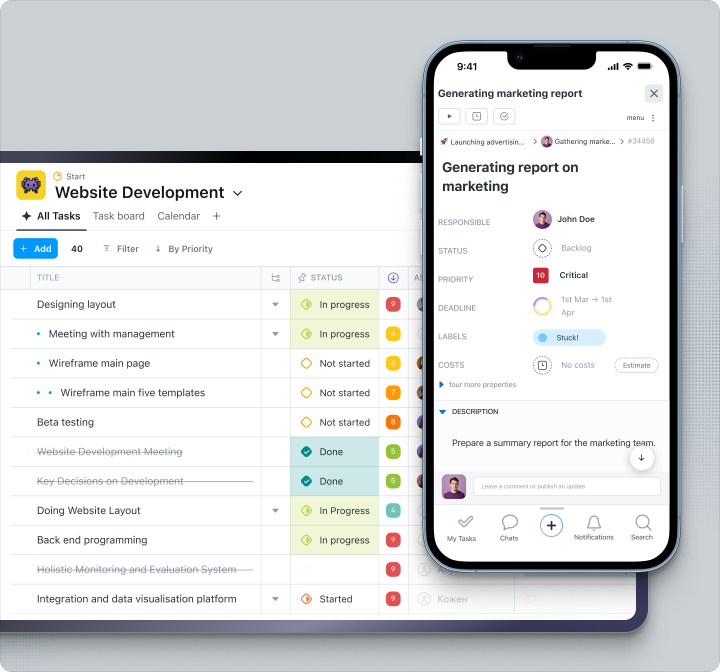
For example, a convenient mobile organizer will reduce the number of missed deadlines and increase the speed of work in the marketing and design departments. Its implementation in the company will save time, thus being a representation of lean production.
For companies
Both the head of the company and an ordinary project executor create value in the product for the client through their actions. All efforts are directed at this.
The benefit for the client does not arise in random moments – at the point of selecting a product, accepting an order, inventory completion at the warehouse, or delivery date.
Value is created through a flow of processes directed at results:
- the online consultant helps choose size, model, and color;
- while placing an order, one can choose a payment method by credit card or cash to the courier;
- with the order, a warranty is included, a coupon for exchange or return, gift cards or invitations to themed events;
- you can specify the date and time of delivery, call the courier, or choose a specific store in the chain for pickup.
In addition to total value and the absence of defective items, the client also values customization of the product, especially in consumer segments. If a company can adjust its conveyor without significant losses to produce various or new models of goods – it will certainly outperform its competitors. For example, creating complex custom sets from basic components or offering exclusive sets on demand already provides a market advantage.
Muda, mura, muri – these are
In the Lean methodology, waste or costs are referred to as muda, mura, muri. Everything unnecessary that should be eliminated. Everything that does not increase value for the client. Muda, mura, muri are words from Japanese that have firmly established themselves in English business slang.
Muda – waste, unnecessary costs. Consequences of management errors.
| Muda | In industry | In IT |
| 1. Transport | Logistics calculation, unnecessary movement of materials, goods, documents, or data. | Unnecessary transmission of information between databases and departments. Unneeded tools or constant switching of documents. |
| 2. Inventory | Excess inventory of raw materials, intermediates, and finished products. | Projects stuck “in the development phase.” The bug tracker filled with outdated requests. Unfulfilled orders piling up. |
| 3. Motion | Unnecessary movement of people across the factory floor, between offices, and between the warehouse and the director’s office. | Fragmented databases, poor search navigation. Physically remote local storage devices. The need to travel constantly to meetings. Numerous tabs in browsers, messengers, or other means of decentralizing data and communication. |
4. Waiting | Downtime for people and equipment. Waiting for instructions, verification, access to information. Lack of tools and equipment for staff to work smoothly. | Lack of all necessary equipment for work, especially for software testers. Issues accessing the database, internet, electricity outages, and other reasons for programmer downtime. |
| 5. Over-processing | Unnecessary processes during processing, overuse of raw materials during production. | After a request for “drafts, preliminary data, approximate indicators,” making final code, deep analysis, or development planning in accordance with rising/falling indicators would be a mistake. |
| 6. Overproduction | Unjustified production of a product before ordering or in large batches. Goods losing relevance before sale. | In a finished project, unnecessary self-action is present, and incorrect references to past situations or technologies exist. |
| 7. Defects, shortcomings | Non-compliance of products with standards, orders, or company regulations. | Non-compliance with the specifications. Additional iterations of corrections required. |
| 8. Talent* | Ignoring the potential and skills of colleagues. Unfair exploitation of labor, bans on employees’ initiatives. | Lack of career growth. Indifference to proposals for optimizing work processes. |
9. Resources*. | Uneconomical operation. Equipment, lighting, and other technical resources should be turned off when work stops (at night, after production completes). | Log out, turn off the PC before leaving. Control the operation of air conditioning, heating, printers, kettles, and microwaves (at the very least). |
10. Excess products* | Alongside the final product, additional products may be created that accompany the creation process. Extra components from metal scraps at the pipe factory, repair services at the old car sales station. |
*muda that is added in some classifications.
Mura – the causes of muda. Unevenness and inconsistency of load, overloads.
| Mura | In industry | In IT |
| Overload | Lack of resources during peak demand, inactivity during downturns. Seasonal sales require hiring temporary additional workers. Additional trains run during rush hour in the subway. Upon winning a tender, finish prior projects beforehand so capacities suffice to fulfill orders on time. | We sit without work for a month, and then need to hurry to complete everything in a week. This is inefficient stress, plus a discrepancy between working conditions and tasks set. Add a social media event announcement a week before the event – failure. A marketing campaign lasting 3 – 4 months with regular postings – success. |
Muri – inefficiency. Unjustified complexities in work.
| Muri | In industry | In IT |
Non-core work | Putting a sales manager on the factory production line. Appointing the factory director as a gift to the third wife. | Performing tasks unrelated to the position and available skills. Sending the layout designer to the call center. |
| Poorly equipped workplace | One set of tools for 4 assemblers. | The trainee has a laptop, but it lacks antivirus and necessary specialized programs for work. The designer has outdated “pirated” Photoshop. |
Unclear instructions | Abstract requirements for an order, measurements by eye. | “Make the layout more cheerful, and the buttons should be wow!” |
| Lack of tools and equipment | One printer in the director’s office, the accounting department constantly runs to print. | A programmer is hired with his own laptop and is required to take it to the office because it may not be possible to buy and equip a desktop computer for him. |
| Lack of proper technical service / unreliable equipment | Outdated conveyor belt, with technical maintenance overdue by half a year to a year. | The system administrator does not systematize and label cables in the server rack. Time to locate malfunctions increases several times. |
| Unreliable processes | Untested raw material processing technologies, abstract accounting methods, and dubious production ideas. | Monkey testing as the only valid way of testing programs for bugs (errors). |
Poor communication and connection | Unsatisfactory sound quality on walkie-talkies in factory areas. Struggling with the director’s secretary when it’s urgent to report an emergency. Bureaucracy. | 2 mobile numbers, 8 messengers, 3 emails, and 5 social networks to obtain consent to execute a task. |
The essence of lean transformation is to eliminate all muda, muri, and mura. Understanding their cause-and-effect relationships allows one to focus on the source of problems so that not every little thing has to be addressed.
Advantages of the Lean methodology
A skeptic might ask why lean transformation is necessary, if it’s possible to simply apply a couple of standard instructions to combat defects from GOST or to cut paper costs on bureaucracy in a company? The methods of lean production as tools are strong, but without understanding the philosophy and structure, it will not be feasible to implement them fully.
It’s like the principle of composing exams at university: “knew-passed-forgot.” After the exam, all that will remain is a breath of relief, but nothing to apply in practice. Likewise with instruction. Implementing a few algorithms to reduce expenses or deadlines does not create lean production. Lean is about constant change. Even upgrading once a year does not mean actually implementing the methodology.
The whole essence is in the experience, running it on practice. Only after personal experience, theory testing and data collection can one analyze and develop new stages of experiments. Establish such a cycle as a norm for implementing corrections, battling against muda, mura, and muri.
To kick off a project under the lean methodology, one needs to:
- gather all information about the future task;
- segment it into subtasks, develop and test them separately;
- calculate all deadlines and budgets based on the collected experience of competitors or own past projects (relying only on real data instead of abstract theories).
Principles of lean production
Based on all muda, mura, and muri, there are exactly 10 principles of lean production:
- Eliminate waste
- Minimize inventory
- Maximize flow
- Production depends on consumer demand
- Know customer requirements
- Get it right the first time
- Enhance employee capabilities
- Build a system with easily replaceable parts
- Establish partnerships with suppliers
- Create a culture of continuous improvement
There are also three basic business tasks. They direct the transformation of the entire company:
- Goal. What problems does the company solve for the customer, and what is the ultimate value for the consumer?
- Process. What are the criteria for evaluating each value creation stream? Verify algorithms and links in the chain, combat waste, inefficiencies, and overloads. Each step is valuable, real, accessible, adequate, and flexible, while streams and influences are uniform.
- People. How to distribute responsibility for each process and production stream? Assign a person not by position, but by the process entrusted entirely? The task curator forms value creation from the perspective of business objectives and actively implements lean transformation.
For individual career development, these same basic three tasks look as follows:
- What is my work goal?
- What is the process for generating the best outcomes in the most efficient manner?
- Who are the people for whom I create value?
Principles of the Kaizen philosophy – continuous improvement
The term kaizen consists of two Japanese characters カイゼン: kai – change and zen – good. Changes for the better, relentless improvements, transforming to good… It is hard to say whether this is a theoretical teaching of philosophers or a practical management method. Kaizen is a symbiosis of both concepts, enabling subordinates to propose and swiftly test their ideas for improving enterprise operations. Lean transformation stems from the practical part of kaizen and is grounded in its philosophy.
Kaizen rests on five pillars:
- Equal interactions across all levels (leadership, managers, workers) and direct communication among them
- Individual discipline
- Healthy moral state of the team and of each person
- Circle of quality
- Proposals for improvements everywhere: from workplaces and production lines to how to assess company performance.
Algorithm for implementing lean production
According to James Womack, founder of the Lean Enterprise Institute and author of several books on transformation:
- Choose a leader – a responsible guide for changes
- Acquire knowledge of lean and kaizen from a reliable source
- Find or create a crisis – a problem requiring immediate resolution
- Experiment, practice, analyze results immediately – do not get caught up in strategy development (as proven by the Wright brothers)
- Build actual and desired maps of value creation flows. They must differ
- Ensure transparency of results for all staff
- Shorten the production cycle time (accelerate flow)
- Implement kaizen and continuously develop the company (value creation on production floors transitions to administrative changes)
Here’s where to begin implementing lean production. Possible tools:
- Value Stream Mapping
- Pull production
- Kaizen
- 5S
- SMED
- Poka Yoke
- Total Productive Maintenance (TPM)
- Just-In-Time (JIT)
- Visualization
- U‑shaped cells
Examples of implementing lean production
A company’s competitiveness often depends on specific criteria. Rapid delivery of tasty pizza will beat just a flavorful pizza. Customizing a car at an official dealership is more appealing than a standard basic configuration. Detailed results from private medical analyses are always better than scant summaries from a local clinic.Providing superiority over competitors (speed, customization, quality of research) can be achieved by continuously improving the project management system, as many companies do around the world.
Successfully implemented lean:
- in the USA: Toyota, Alcoa, Boeing, Pella, Emerson Electric, Jacobs Equipment Company (Danaher);
- in Europe: Motoman Robotec, Unior, Iskra Asing, Volvo, Metso, Nuon;
- in China: Lenovo, Suntory;
- governmental and municipal bodies in many countries.
Applications and tools related to Lean
Implementing transformation in a modern company is easier than it was 30 years ago. For Android and iOS, there are many similar applications that help maintain a lean and quality-oriented business.Tools for lean production are used to motivate staff, build relationships and connections between the workshop and management, analyze the results of new idea implementations, and identify losses in the functioning of the enterprise. Testing and experiments, developing conveyor systems or a bug tracker for programmers – all of this is software for the Lean methodology.
Worksection
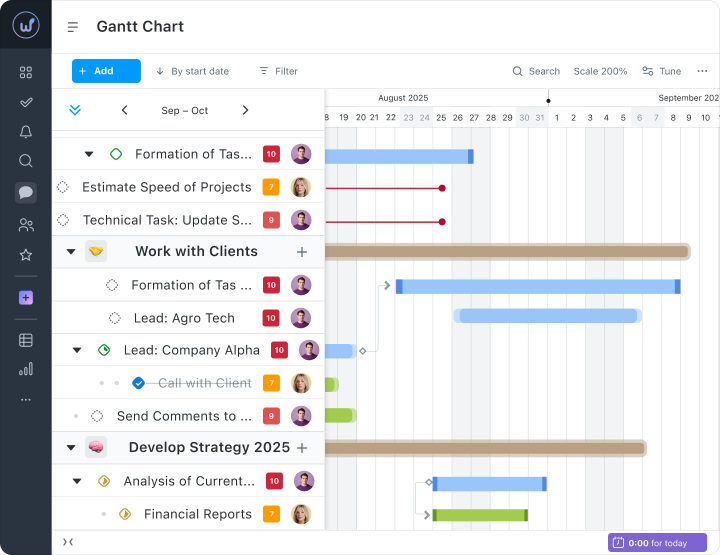
Worksection is a SaaS service that includes complete functionality for project management, Gantt charts, and several types of reports.
The Gantt chart allows tracking relationships, timelines, and accountability for tasks. The reports highlight overdue tasks and exceeded budgets.
In the “people” task section, the manager can see workloads for each individual and who is underloaded. This makes it easy to identify uneven distribution of human resources.
Because of this, the fight against muda, mura, and muri becomes visible and straightforward.
One can create a separate project called “team suggestions,” where ideas for implementation can be added in the form of separate tasks.
Set a deadline for two weeks or a month to test the idea, discuss the process in comments, and then analyze the outcome.
If the idea is good – implement it permanently.
Oracle

LeanApp
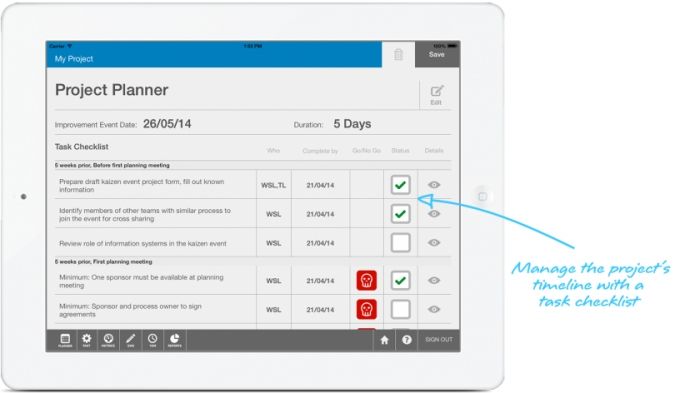
The most famous application – LeanApp for iOS allows you to systematize and control all processes in the company.
Conclusion
Companies worldwide implement lean production, but not all succeed with this approach. Many do not know how, do not understand the philosophy, or incorrectly apply the learned instructions in practice.
The essence of the methodology
- elimination of waste;
- empowerment of employees;
- reduction of inventory;
- increased productivity.
Begin the fight against waste in the most “narrow” places of the workflow – where the error is critical.
Finding and resolving a crisis is much more effective than thoughtlessly implementing the Lean algorithm.