Even the most effective and proven tools must change, improve, and adapt to market realities over time.
A bright example of this is Lean Six Sigma. In some ways, it is an innovative combination of process management methods based on the principles of Six Sigma. Their feature is the ability to be successfully implemented not only in manufacturing but also in any area of business.
Lean Six Sigma: What is it?
Lean Six Sigma (LSS) is an integrated methodology based on American and Japanese methodologies:
“Lean manufacturing” (in other words, Lean production) refers to actions aimed at reducing waste in production and speeding up the processes of releasing finished products; standardized solutions are actively supported;
“Six Sigma” – actions designed to improve the quality of produced goods and, consequently, increase customer loyalty; the basis of decisions, often absolutely non-standard, is data analysis.
What is “Lean manufacturing”?
This philosophy is also referred to as lean manufacturing methodology, lean methodology, lean production. The founder of this method is Taiichi Ohno, the ideologist of the Toyota production system (although Ohno did not use the term himself, the name lean production was introduced by American John Krafcik, currently the CEO of Waymo, a company that creates self-driving cars).
The algorithm of lean production was also developed by James Womack, Michael P. P. W. Womack, Sigeo Shingo, Jeffrey Liker, Dennis Hobbs, who contributed significantly to the concept used today by leading global companies. Meanwhile, the concept itself has transformed and expanded. Initially, it was about lean manufacturing, but today it is more accurate to talk about a lean enterprise.
One of the main points often forgotten is that a perfectly tuned production process means nothing if chaos prevails in other aspects of the company’s activities. The priority task for the manager is to understand what is happening and find hidden losses.
To minimize them in the future by creating the right climate in the company:
As a leader in your organization, whether large or small, you can make the biggest contribution to the company’s development by motivating and supporting those who will take on the transformation according to the Lean production system. Like a conductor of an orchestra, you don’t need to play all the instruments, but you must know the notes perfectly and guide the orchestra…
Michael W. W. Septić
Despite the fact that the lean methodology has been used in Japan for over 60 years, and this philosophy was adopted in the USA in the 1990s, its key principles are still relevant today:
- Workers are not just variable cogs in the system; they need to be truly involved in all production processes, from the simplest to the most complex; this is possible only with genuine respect from management for employees and an understanding of the need for continuous professional growth for each employee of the company;
- team task management must integrate technologies, regulations, and human resources;
- the key factor for success is changing the corporate culture.
Lean is a culture of continuous operational improvement in the company. It is an ongoing effort to eliminate waste and increase efficiency. It is each employee’s personal attitude toward how effectively they perform their functions and how the processes at their workplace provide additional value to customers. In order to achieve maximum operational efficiency, it is necessary to improve all processes not only from the perspective of the company but also from the perspective of the customer…
Igor Polishakov, Transformation Director of Kyivstar
Which companies use Lean methodology:
- General Motors
- VALEO
- Ford Motor Company
- New Balance
- Caltex
- Tikkurila
- “EVRAZ UKRAINE” and others.
It is encouraging that processes aimed at the wide implementation of this practice have also intensified in Ukraine:
Today lean is one of the best global practices for improving the efficiency of any organization, regardless of its size or field of activity. We believe that a deeper understanding and application of the culture of lean production will contribute to a serious transformation of Ukrainian business, enhancing its competitiveness in European and global markets and ultimately becoming a significant contribution to the social and economic development of the country…
Sergiy Komberyano, President of Lean Institute Ukraine
What to read:
- Womack, James P., Jones, Daniel T., “Lean Manufacturing: How to Eliminate Waste and Achieve Prosperity for Your Company.”
- Michael Thomas W. Wader, “How to Assess Your Company’s Leanness. A Practical Guide.”
- Don Tapping, Anne Dunn, “Lean Office: Eliminating Wasted Time and Money.”
A little history: what is “Six Sigma”?
It can be said that the history of the development of the concept began with this phrase, which was said in 1979 at a Motorola board meeting:The real problem with the company is that the quality of our products is horrible!
Art Sandri
This statement prompted leaders to reconsider their methods and principles of work, as 5 – 20% of the company’s revenues (up to 900 million dollars) were spent on eliminating defects in products.
Changing the situation was difficult, as the path from production lines to the end consumer is long and convoluted. As a result, statistics were used, allowing achieving the desired result.
The basis of the Six Sigma concept:
- Sigma (Greek letter σ) – the standard deviation, which demonstrates the magnitude of deviations for a specific sample (measuring the results of a process under different input data).
- The more opportunities for variation of internal and external production factors, the higher the level of quality deviations.
- The smaller the range of values for a specific characteristic, the higher the quality of the produced goods.
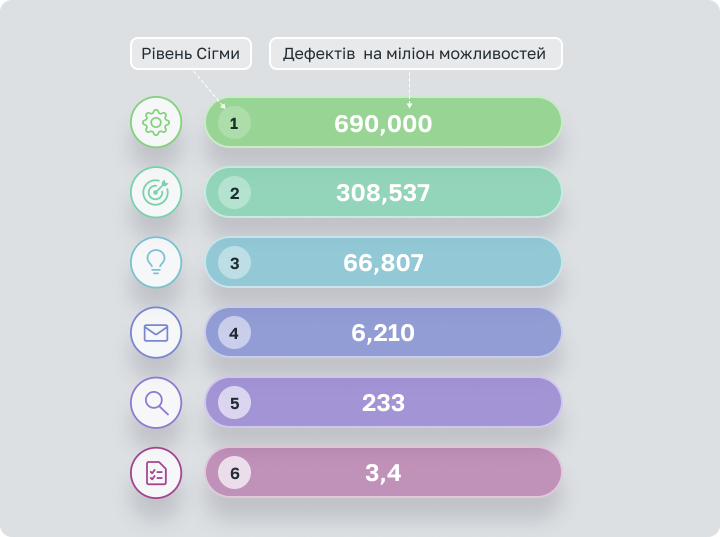
The larger the numbers, the clearer the advantage of using the Six Sigma method. Thus, for Motorola, the 6 sigma rule became a method to save about 14 billion dollars and increase sales by 5 times (over 10 years since the implementation of the 6 sigma method).
If a process functions at the level of one sigma, it means that it produces more defective items than acceptable products from the external consumer’s point of view.
Gregory Watson, President and Managing Partner of Business Systems Solutions, Inc.
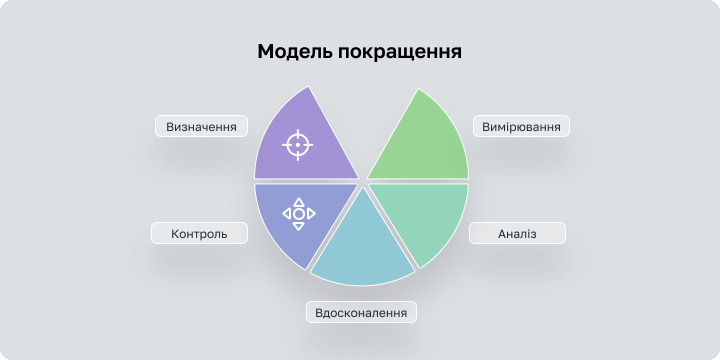
To standardize work with the 6 sigma system, a special step-by-step algorithm named DMAIC was developed:
- define
- measure
- analyze
- improve
- control.
Visually, the process of working with the 6 sigma concept can be imagined as follows:
The methodology indeed works for various fields and countries, as:
- The average salary for professionals with a Six Sigma Yellow Belt certification is 68,294 US dollars (according to Burning Glass).
- Those who mastered the principles of Six Sigma earned more than those who did not: +12,475 US dollars in Canada (according to ASQ.org).
In addition, the methodology is used by companies such as:
- General Electric
- Ford Motor Company
- 3M
- FedEx
- KrAZ
- Caterpillar Inc
- Honeywell.
What to read:
- Craig Gygi, Neil DeCarlo, Bruce Williams, “Six Sigma for Dummies.”
- Peter S. Pendy, Robert P. Newman, Roland R. Keveneg, “The Six Sigma Way: How General Electric, Motorola and Other Top Companies Are Honing Their Performance.”
Benefits of Using Lean Six Sigma
- When talking about the global benefits of using the symbiosis of lean manufacturing and Six Sigma, their list resembles a puzzle, where the shortcomings inherent in lean methodology are successfully compensated by the Six Sigma approach (and vice versa):
- The foundation of lean manufacturing is the elimination of waste, such as defects (defective products). At the same time, it does not involve searching for and calculating the options of where this defect can come from. And, of course, there is no work done on finding ways to reduce the variability of internal and external production factors. But in the Six Sigma concept, this is prioritized.
- Since the Six Sigma methodology was originally developed in the context of improving customer satisfaction, all its key points are tied to tracking the relationship between “process feature — end-user satisfaction level.” In lean manufacturing, this metric relationship is not monitored.
- The Six Sigma methodology requires the initial establishment of formalized procedures for implementing the concept. First and foremost, the responsibilities of management, the specifics and timing of training, metrics for tracking progress or regress, etc., are defined.
- Lean manufacturing deals with several types of waste characteristic to the enterprise, while Six Sigma focuses on defect elimination.
- Time and “frozen” assets are very important factors that can be optimized during lean manufacturing, while in the Six Sigma methodology, these criteria are not considered.
Principles that Help Achieve Project Success Based on Lean Six Sigma (LSS)
- Main focus – fulfilling customer needs. First, it is necessary to establish the benchmark below which customer and market requirements are not allowed to fall. It is also important to understand what is valuable in your product for the customer and to develop it. And what does not represent value – to discard.
- The guarantee of success – data collection to identify specific problems and combat them. Statistics are essential! The causes of defects and customer dissatisfaction are often not obvious. One should not try to tackle everything at once. This will only lead to chaos.
- Establish communication. All participants in the work process must know the principles of LSS; otherwise, it will result in disaster rather than progress. Education is everything!
- Track results and adjust them. Motivate individual and professional growth of employees, without turning them into silent executors of orders from above.
Qualification Levels in Lean Six Sigma
- “Black Belt”: a person who will become the strategist of the company and globally manage the process of implementing LSS;
- “Green Belt”: individuals who become the driving force behind the implementation of the Six Sigma concept, ideally, before starting training, an employee aiming for this title should choose a mini-task within the company that requires practical work during the training;
- “Yellow Belt”: work under the direction of “Green Belts”, performing narrow specific tasks in which they can and should be true experts;
- “White Belt”: indicates that a person has mastered the basic set of knowledge and understands what the Six Sigma methodology is.
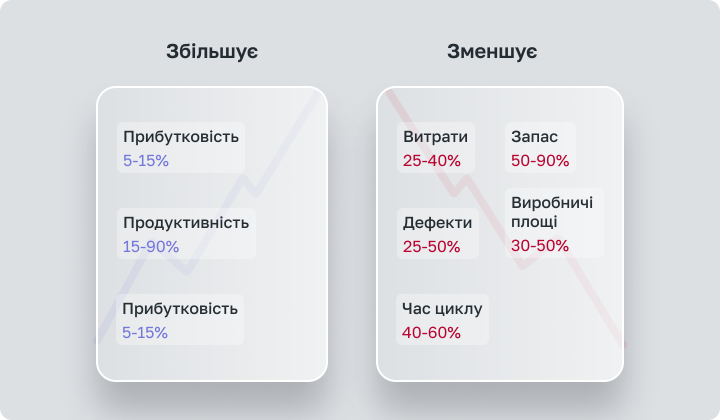
The results of applying Lean Six Sigma are impressive:
Who Benefits from Using Lean Six Sigma?
In fact – everyone. Of course, it is often heard not about how to implement this methodology within the structure of their company, but rather about why one should not even try.There are two main reasons why people start implementing Six Sigma. The first is that the company is in crisis and needs to do something to get out of the “hole,” or when competitors are eating you alive. The second is when a company wants to improve the quality of its products and always be at the top…
Rhino Domenico, President and CEO of Sterling Business School
So, who can use this methodology:
- Those who have very little time. Yes, Lean Six Sigma will enable optimization of processes and eliminate what does not bring value.
- Those who are not the giants of the industry. Perhaps they are not giants because they spend time and money eliminating their own mistakes due to a lack of necessary skills?
- Those who have little money. Implementation of the concept can be started with introductory webinars (often free) and reading literature (not so expensive, especially if you buy e‑book versions).
- Those working in the service sector. Yes, this methodology is suitable for any business with repetitive operations (order formation, delivery organization).
- Those who are not very familiar with statistics and do not have specialists of that profile on staff. The formulas for calculations are quite simple, and in general: there are online calculators.
Which companies are already using the methodology:
- AT&T
- New Style JSC
- Wal-Mart
- Agrogeneration
- Starbucks
- DTEK Energy
- Merck
- ATB
- Kyivstar
- Mariupol Ilyich Iron and Steel Works
- Coca-Cola.
Tools needed for developing Lean Six Sigma in the enterprise:
- 5S — the system of organizing and rationalizing the workplace;
- Makigami maps;
- Ishikawa diagrams;
- 5 Whys;
- poka-yoke (baka-yoke, poka-yoke);
- statistical tools;
- Gantt charts;
- Pareto charts;
- and more.
What to read:
- Michael L. George, “Lean Manufacturing + Six Sigma in Services: How the Speed of Lean Manufacturing and the Quality of Six Sigma Help Improve Business”.
- Jeff Cox, D.J. Jacob, Susan Bergland, “New Goal: How to Combine Lean Manufacturing, Six Sigma, and Theory of Constraints”.
Conclusion
The Lean Six Sigma methodology is a solution for those who are used to being ahead. As you apply the methodology, you achieve results when the rest of the market participants have not yet realized the need for a particular technique.As practice shows, this concept is adopted by high-level professionals who achieve remarkable growth figures, regardless of initial conditions.