
You held the Product Owner position at two companies: OSD Group and later GeniusMarketing. How many employees did the companies have, and [what’s specific about how GeniusMarketing operates?
OSD Group employs about one hundred people. GeniusMarketing – about 80. GeniusMarketing is an education project teaching digital marketing for business owners and specialists in various fields. It also fosters development in this area.
Who is the Product Owner? What is the nature of this job?
It varies from company to company. At GeniusMarketing, the Product Owner is like the manager of a line of products linked by a single criterion. I was the Product Owner working with entrepreneurs.
Our products were for entrepreneurs. We taught people how to take a business to the next level and how to grow it using internet marketing.
My task: to create great products that would sell great.
There were projects we’d already worked on, but there were also new ones we created without knowing whether or not they’d take off?
It depended. There were projects previously run, but there were also new ones, which we created without knowing whether or not they would take off.
How did you first hear about the Worksection task manager?
I’ve known Worksection for a long time. Before GeniusMarketing, I worked at OSD Group, a major marketing holding. There I had a team of managers and more than ten projects that I ran simultaneously. Eleven departments, all interconnected. Each department had subdivisions. The subdivisions had many employees.
On the whole, we needed a system that could help us [manage projects comprehensively. We couldn’t lose or forget anything. We had to track deadlines. We needed to store projects whose number kept growing.
At first, we rolled Worksection out in our own department. It clicked with us. We scaled it up to the other companies. For a year and a half, I worked as a Worksection manager at OSD Group. At GeniusMarketing, we also reached the decision that we needed to introduce a project management system.
Worksection was the first thing that came to mind. I recommended it. The owners looked into it, tested it, and rolled it out.
Does the whole team work in Worksection?
The whole company switched to Worksection long ago. We’ve now even brought our contractors into the task manager. There are teams and there are projects. For each project, I invited the people needed to work on it.
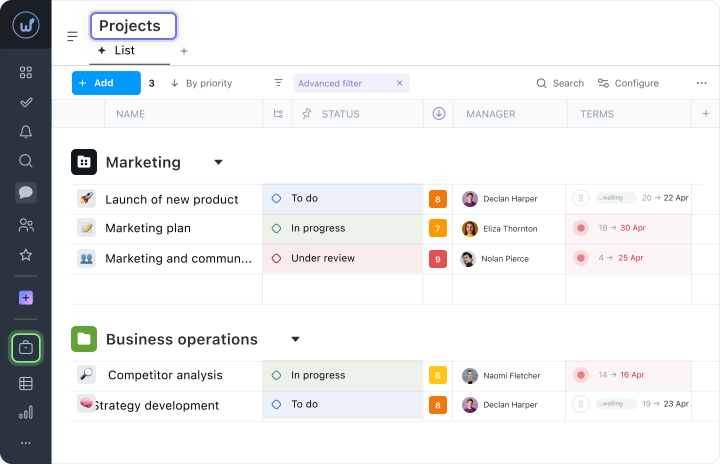
We’ve developed an internal company policy for using Worksection. Everything has to be in Worksection. If it’s an external contractor, the time they spend has to be tracked. If a task wasn’t set in Worksection, it meant it was low priority. Everything is recorded in the task manager so we can understand how loaded the teams are.
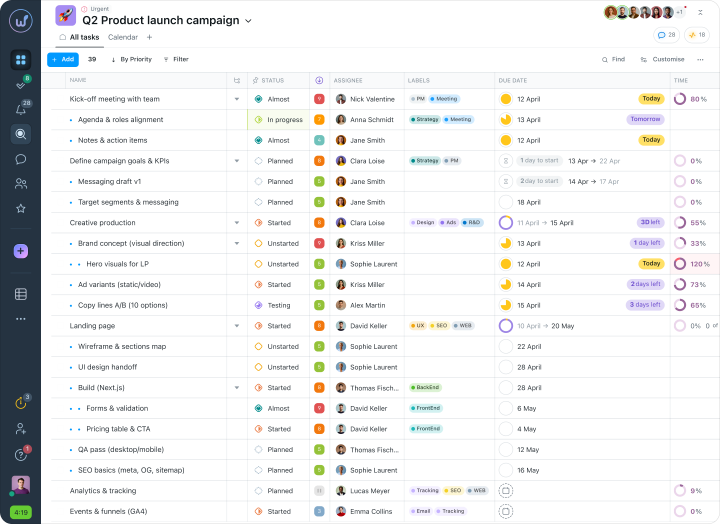
Which Worksection features do you use?
In spring, GeniusMarketing switched to unit economics. We completely rebuilt our internal way of working. We moved designers, copywriters, and YouTube and onto performance-based (project-based) pay. We shifted more toward outsourcing and started using time tracking.
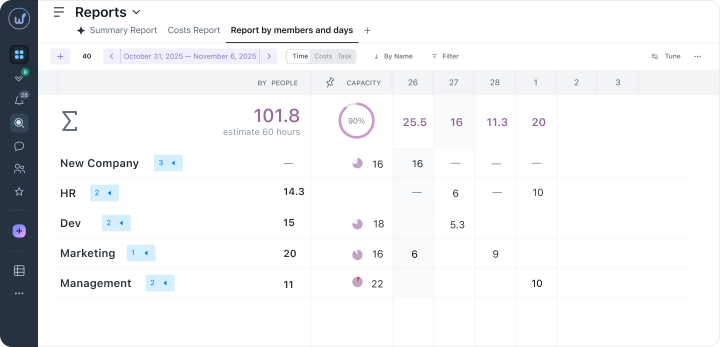
We use time-expense reports to understand exactly how much time and money we spent implementing a project.
We use time-expense reports to understand exactly how much time and money we spent implementing a project.
This year showed everyone that if you’re not online, then you and your business basically don’t exist.
Many specialists, on the other hand, decided to learn internet marketing. For example, people who used to work in tourism reskilled and became digital marketers.
What is inconvenient in Worksection?
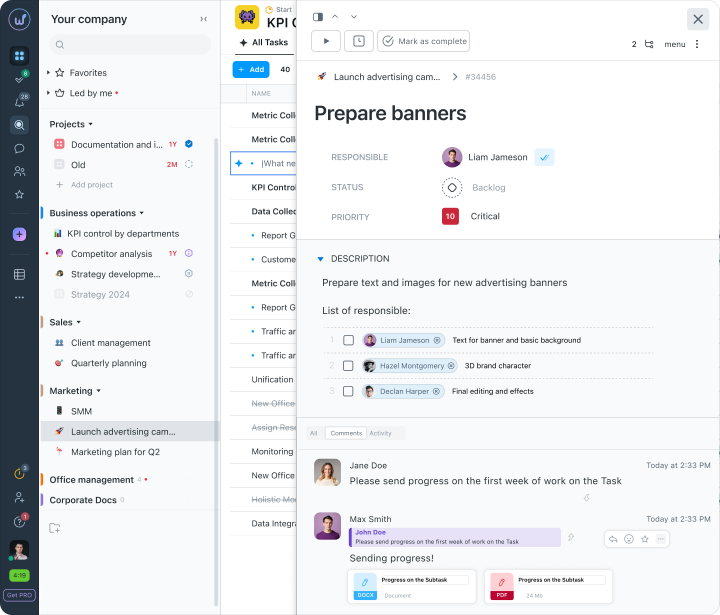
Personally, I have no complaints about the UX. The three-minute tutorial video is enough to understand how to use Worksection. You set a task, then a subtask, then you get to work.
What’s the main reason you chose Worksection specifically?
Worksection has all the functionality a mixed team needs. You set a task, upload the data into the Gantt chart. You make adjustments, and everything updates automatically. Before Worksection, we built Gantt charts in Excel — coloring them in by hand.