
What is the activity of Twiga Ukraine
Twiga Ukraine is a single organism comprising 6 agencies. The expertise of our agencies is enough to cover all needs of a client. Twiga Digital is one of the agencies.
The company carries the giraffe’s values.
(“twiga” means “giraffe” as translated from Swahili)
Of all the animals in the world, the giraffe has the biggest heart. It can run for a long time without drinking or eating. We joke that our team is like a giraffe: we can work 24⁄7 and need nothing more.
We have both internal and external clients. The external ones are Pepsi, Roshen, ProCredit Bank, Henkel, Royal Canin, etc. These are direct clients, and everything is simple and clear with them. And also, there are internal clients.
For instance, our Twiga Go agency won a big tender to execute the creative idea and strategy for a festival for PUMB Bank. All the other Twiga Ukraine agencies also get tasks to work on this project.
How was the work structured in Twiga Digital?
Two years ago, when I joinedTwiga Digital, the agency used mail, Telegram, and legs to communicate (editor’s note: laughing). It was very hard. Need to ask something? You walk to another wing, for example, to coordinate a task with a designer. Once we’d discussed the idea, we recorded everything in email.
The main thing is, when you have 45 people all in the same project, that’s where the fun begins: someone doesn’t find out about a task on time, someone in another wing gets forgotten, someone misses an email, and so on. So much information got lost — it was like a game of telephone. Now we have briefs, and everything is stored in one place.
Before Twiga Digital, I used Worksection for 5 years at my previous job, and then spent six months at the new place without it.
When you “step on the same rake” again, you think: “If only we’d been using Worksection from the start, we wouldn’t have lost this…” A month later, I said: “Guys, we need a task manager.”
Why did we choose Worksection?
It's intuitive, and it's very easy to explain
to people how to work in a task manager.
Alongside with Worksection, I had an experience of dealing with clients in Trello, Bitrix24, and Asana. But Worksection suited us in the best way.
Worksection doesn’t require creating 45 subtasks for each person. Within a single task, you can spell out subtasks, tag the people concerned, and mark with a “bell” the project manager who needs to see the task. The functionality is well thought out.
Was onboarding quick?
No :( But, it was very smooth and comfortable.
At first, we used Worksection only in the digital agency. Compared with Asana, I already knew that in Worksection it’s easier to choose the person responsible create a task, and remove employees from a team — for example, if they’re being distracted by notifications from a task they’re not working on.
There are many features that set it apart from other task managers.
As time passed by, our creative people (Lions is also one of the six Twiga Ukraine agencies) also realized that Worksection means convenience. We held an introductory training, and one of the six agencies agreed to have a trial of the task manager.
Our Media First agency was the first to join. Then two more agencies followed.
Today, five of the six agencies are connected to Worksection.
We ran several Worksection training sessions for our employees, set up the basic configuration, and we plan to connect our clients to the task manager by giving them access to projects, since it matters to them.
For example, project designers will track the time spent on a project, and the client will be able to see that information to make an hourly calculation under the contract.
In Worksection, our clients clearly see: when a task was set, how much time was allocated to it, the time-session count, and tracking for each individual employee. The client receives a report every day.is.
How do you handle reporting in Worksection?
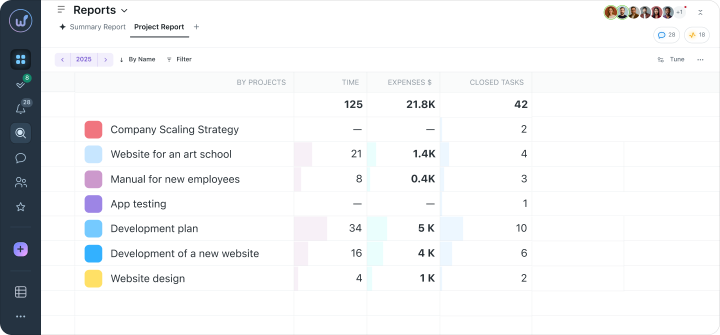
We make reports by projects and by clients.
It’s very convenient. Internally, our agencies have a document report and a task report, so we don’t forget “who owes what to whom.“
For example, a project report:
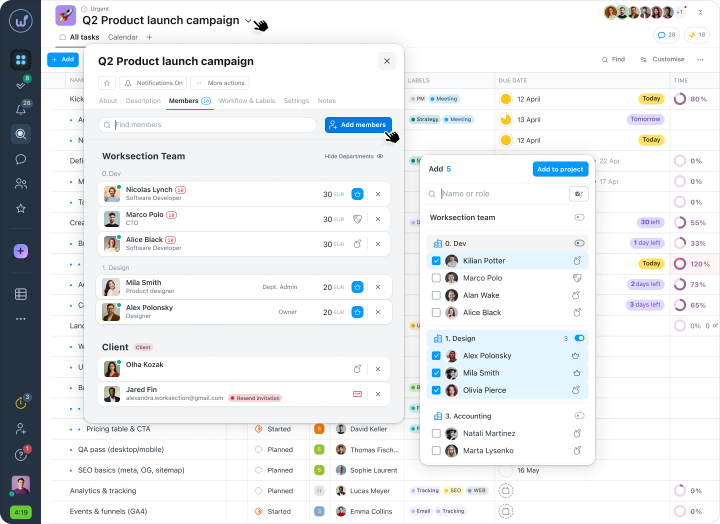
One of our clients asked: “Can I buy a tool for recording reports?” We said there was nothing to buy. Worksection was already there. In Worksection, we created an account for the client, added 8 people on the client’s side, and set up a single profile for them.
For clients, we export the reports to Excel spreadsheets and send them out. There’s a template for it.
What types of projects do you use in Worksection?
We split the work among the agencies, which run their own projects.
And we have a shared project — “New Business.” It brings everyone together. When a new project comes up, we create a team for it right away. We send notifications to the people who’ll be involved in the project.
This is what the hierarchy of the most important part of Worksection — working with tasks — looks like:
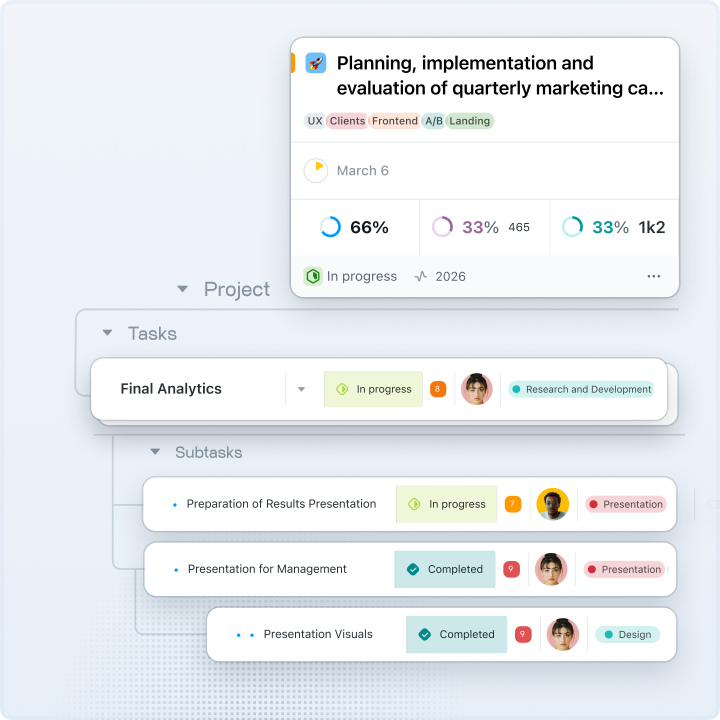
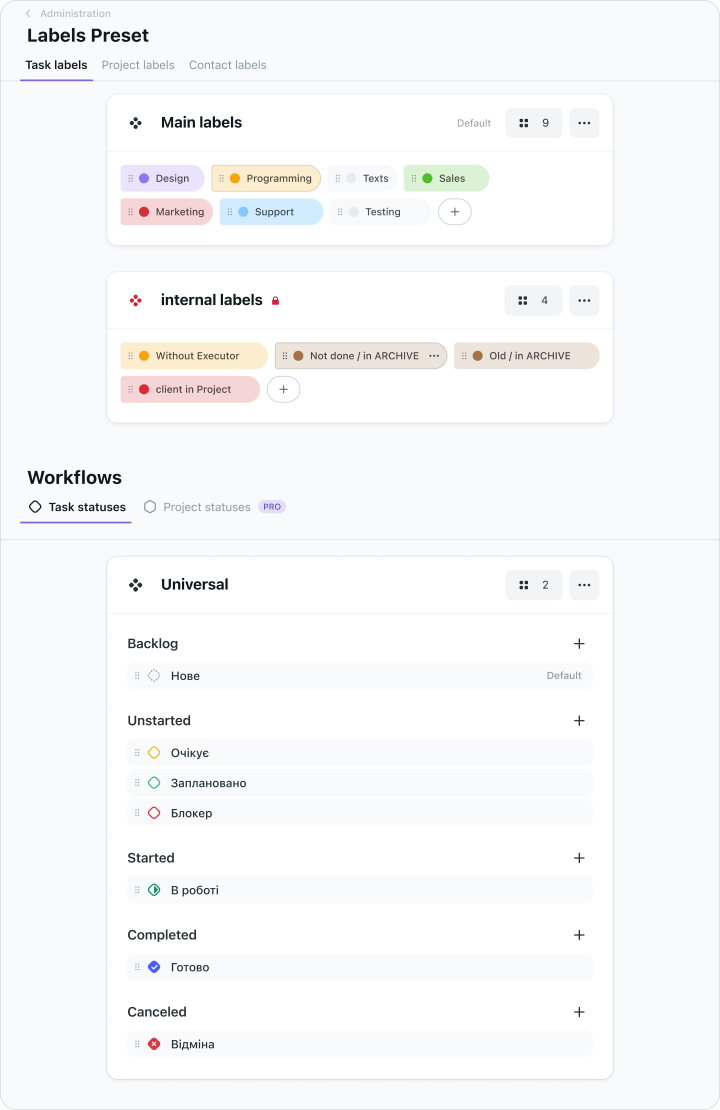
We put labels on projects. For example, a client put something on hold because of quarantine. Or a budget was cut and the discussion pushed to next year.
It’s then very convenient to see how many projects we’ve handled in total, how many tasks we’ve closed, how many pitches we won and lost, and how many projects are on pause.
Worksection is a real lifesaver for remote work. There’s a lot of communication, and it’s now 24⁄7. These days, designers, creatives, copywriters, and influencers work remotely. They might come into the office once a month if they need to talk with a client..
We handle all our client and internal matters in Worksection. Everything to do with administrative matters lives in separate folders. They’re placed in subtasks. All the access employees need is there.
Do you bill your employees’ work hourly?
We don't.
Unfortunately, employees still have a negative attitude toward time tracking. Of course, we explain that by using tracking, you help both yourselves and us. It’s important for both the client and us to know how much time a task took.
What’s the main value of Worksection compared with other task managers?
It’s completely clear and easy to work with. For example, people often say iOS is clear even to a child. It’s the same with Worksection: everything is visible, there’s nothing to search for, and you don’t need to read any instructions before using it. Nothing is hidden — all the features are visible at once.
You spend 5 minutes creating a task and notifying people, and they get to work on it right away. Right there, you can also see how many people have already viewed the task. It’s like an open chat.
Internal company rules for working in Worksection
The first rule: reply in Worksection to confirm you’ve taken the project on. Another rule: setting a task doesn’t mean it’s been accepted. So it’s better to send a link to the task in a messenger too.
Closing tasks and cleaning up the project are where we “limp.” It’s important to check the deadlines set for a task. If a deadline was missed because of a specific person, we find out the reason.
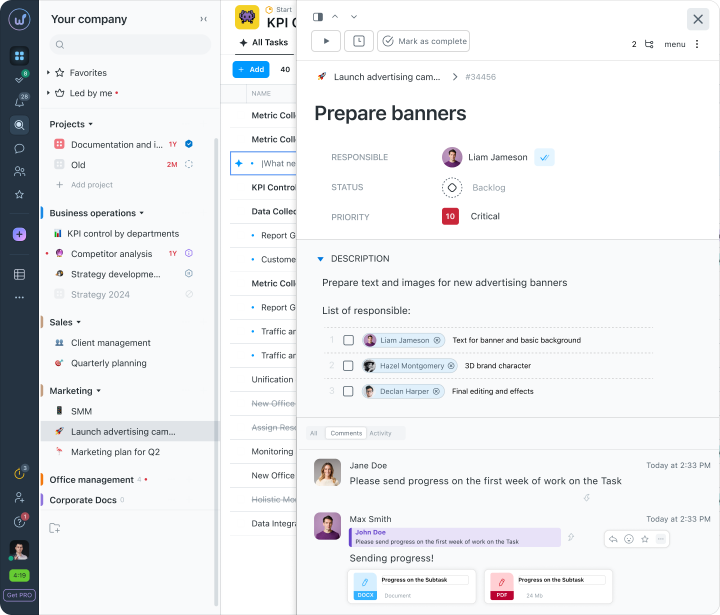
One more important rule: you close a project in Worksection and always analyze the work done.
Once you’ve spent time setting a task, you understand what you’re missing for the team to complete it.
What else do you like in using Worksection
This task manager teaches you to work correctly. Correctly is when everything is clear in the task, with no questions from employees remaining. They clearly understand what should be done.
For me, Worksection is a litmus test. Are we working well or badly? Before Worksection, we had no litmus test. In email, everything gets lost, and correspondence after 6 pm is horrible.
For example, we recently had an unpleasant situation with a project. I log in to Worksection and read the comments under the project. And then I understand where the problem was. I can see the whole structure at once: where it started, when the client sent corrections, when they were made, who and what caused the delay.
I always come to a meeting with a client well-prepared. That matters, especially if you’re the company’s leader.
If you want to be efficient, if you want to do high-quality work and keep to deadlines — you need Worksection.
Support responds quickly, too. Wherever you are, you see the support icon and don’t have to search for anything. You get a reply within 20 minutes at most.