
Y&R Ukraine in figures:
- Its activities commenced in 2006;
- 26+ employees in 5 sections;
- 19+ major companies, including Danone, Microsoft, Colgate, Life, Watsons, Obolon, IDS Borjomi Ukraine etc.;
- 10 ad infinitum of projects handled per month.
Hello, my name is Dmytro Barsukov, I am the СЕО CEO of the Ukrainian division of the international advertising agency Young & Rubicam.
When 1 – 3 persons are involved in work, they can sort things out between themselves, jotting the details down in a notebook or in Google Docs. But when a lot of people take part in the processes, with different workloads and levels of knowledge, you need a system. And that system has to be as user-friendly as possible. It’s not people for the system, but the system for people.
What makes an advertising agency’s work distinctive
The nature of our work explains our complex structure: the company is divided into departments, which, in turn, are divided into sections solving particular problems. The number of projects is an unstable variable: anywhere from 10 to countless. We needed a set of tools for time tracking and deadline management. That’s how we arrived at Worksection.
An agency’s work can be limited to one or two clients who order advertising for a dozen brands. With Danone, for example, we worked on commercials for their brands Rastishka, Zhyvynka, Prostokvashyno, Aktimel, and Danissimo.
Time tracking in the advertising agency is the international standard which (very hopefully for us) will become our national standard. The nature of the advertising business is such that we’re essentially selling our specialists’ time. Thus we initially use the system focused on time tracking.
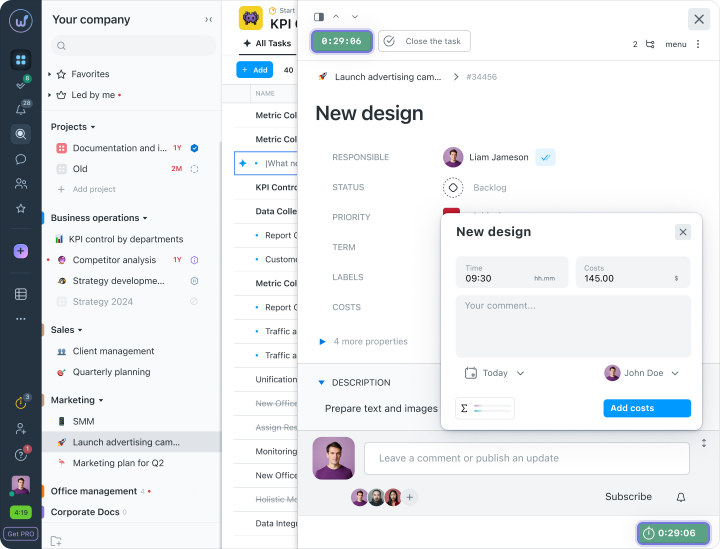
Time tracking lets us run two kinds of analysis:
- internal — assessing how efficiently each employee in a section or department works;
- external — assessing the cost of the work.
Importance of time tracking
Back in 1998, there were already time-tracking products on the market. Convenience, of course, was out of the question back then. Paradoxically, the time-tracking systems ate up more time than doing without them! But they’re still a powerful tool.
When it comes to working with a client, tracking the time spent lets you see how profitable that client is and makes the service more convenient for them.
It would be a perfect solution: bring the client into the project so they can check the scope of work at any time
We’ve brought only a few clients into the system. The rest can’t quite bring themselves to, since few of them are interested in the behind-the-scenes side of an advertising project.
Data acquisition and analysis
One of the key differences between project management of local and international companies consists in software. International companies often develop it “to suit themselves”, with embedded modules, including timing. And for them the question of data collection isn’t as pressing. In such companies, project management = control + planning of implementation. For us thought, what comes first is the ability to track dynamics and working time, and to use them to understand efficiency.
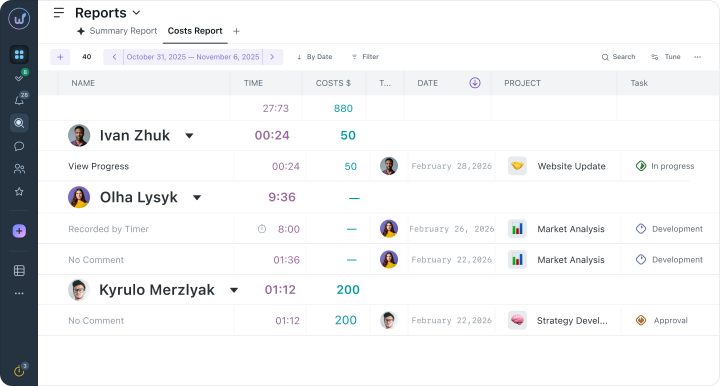
As a result, once you’ve collected time data over a long period, you can work out how many hours — and therefore how much money — a particular task or project costs.
It becomes clear that one person spends 10 hours on a task, while another employee does a similar one in just 2 hours.
Who would you recommend Worksection to?
First and foremost, to large agencies — the ones that face a lot of tasks every day, split across the company’s key units (sections, departments). For companies that need planning and want to scale their business, it’s inevitable.
The bigger the company is, the more unwieldy its processes become. Thus, at this stage of development of Y&R Brands, we value the ease of operating Worksection even more than its functionality.The ones Worksection definitely won’t suit are “single-project” companies that care less about results and growth than about how much budget they can carve up.
We value Worksection for:
- convenience of data acquisition;
- low adaptation threshold;
- the ability to customize it for specific nature of any business.
An advertising agency is a company whose main product is creativity. And until robots take over the creative industries, this remains a “person-to-person” business.