Choosing a project management approach often determines whether the team will meet budgets and deadlines. A mistake here can be costly, so it is important to understand the fundamental differences between the two main methodologies.
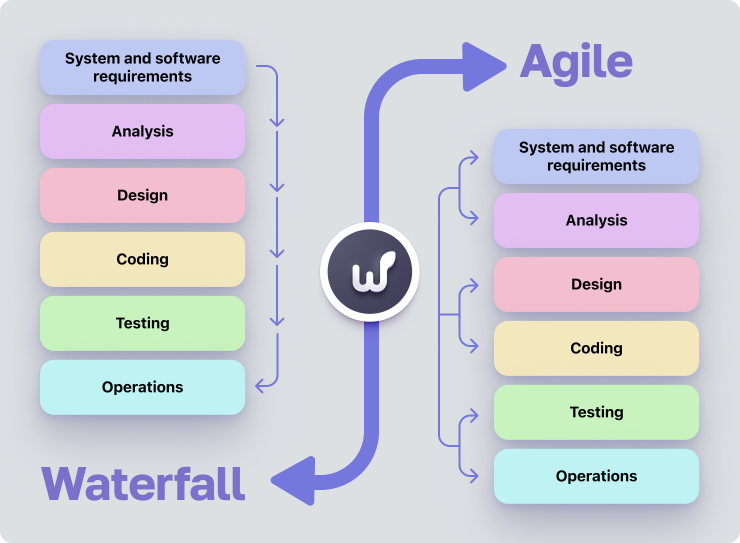
Waterfall and Agile differ in their way of organizing work: the Waterfall model leads a project through predefined stages sequentially, while Agile involves short cycles, regular feedback, and the ability to change priorities. Waterfall is convenient when requirements are stable and the result can be planned in detail upfront; Agile is used when the product needs to be refined during the work process.
Historically, the Waterfall approach is associated with the formalization of sequential software development in the second half of the 20th century, while Agile is linked to the Agile Manifesto of 2001. Today, both approaches are used much more widely beyond IT: the choice depends on the stability of requirements, the cost of changes, regulatory constraints, and the mode of interaction with the client.
What is Agile
Agile is a set of principles for flexible management, where the team works in short iterations, regularly shows results, and adjusts priorities based on feedback. Various practices and frameworks built on these principles include Scrum; for visual task flow management, Kanban is often used.
At the core of Agile are four main guidelines: focus on working results, constant contact with the client, flexibility to changes, and regular work on improvements. The team has the freedom to choose practices, guided only by this shared system of values.
Advantages and Disadvantages of the Agile Method
Advantages of Agile
- Flexibility to Changes. Priorities can be reviewed between iterations without a complete overhaul of the whole project.
- Quick Feedback. The client or user regularly sees interim results and can clarify requirements.
- Early Working Result. The team gradually releases parts of the product instead of waiting for the entire volume of work to be completed.
- Transparency of Progress. Short cycles allow for more frequent checks on what has been done and what is blocking the team.
Disadvantages of Agile
- Harder to Fix Final Scope. Requirements can change, making final deadlines and budgets sometimes harder to determine at the start.
- High Communication Requirements. The team, client, and stakeholders must regularly synchronize.
- Need for a Mature Team. Self-organization and prioritization work worse without clear roles and responsibilities.
What is Waterfall
The Waterfall model involves sequentially passing through stages: the next phase begins only after the previous one has been completed and approved. The plan, requirements, budget, and checkpoints are determined as early as possible, and for scheduling subsequent work, it is convenient to use a Gantt chart.
Stages of the Waterfall Model
What needs to be created
How and in what terms we will work
What the result will be like
Creating the product
Quality check
Handing over to operations
Design → Implementation → Testing → Launch and Support.
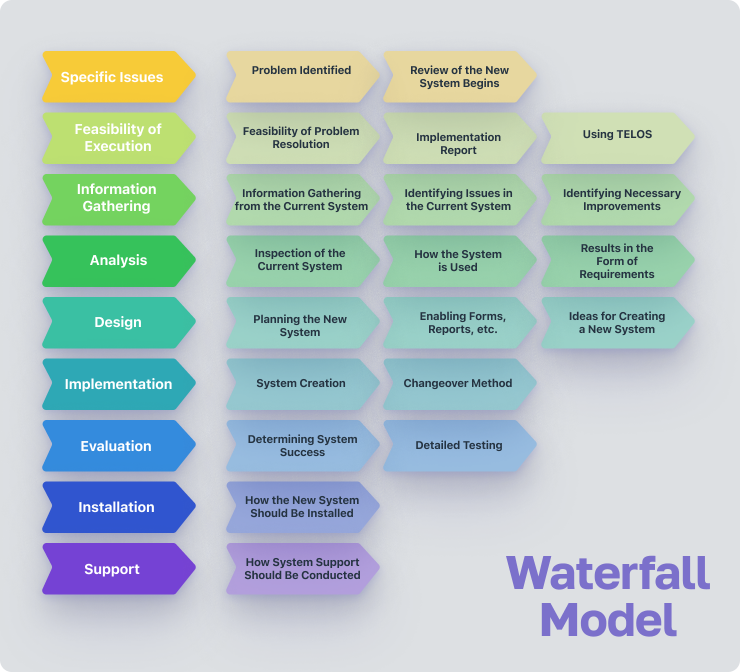
1. Define Requirements
What happens: the team gathers and agrees on functional, business, and technical requirements. Output: an approved list of requirements and acceptance criteria. Typical mistake: moving to the next stage while leaving critical requirements ambiguous.
2. Analyze and Plan
What happens: requirements are translated into a work plan, resources, dependencies, timelines, and risks are assessed. Output: an approved project plan and checkpoints. Typical mistake: building a schedule without a buffer for dependent tasks and approvals.
3. Design the Solution
What happens: the team defines architecture, structure, interfaces, technical solutions, or other models for the future result. Output: specifications, mockups, and project documentation. Typical mistake: starting implementation before key decisions are agreed upon.
4. Implement
What happens: the team creates the product, object, or result according to the approved requirements and design. Output: a deliverable ready for inspection. Typical mistake: subtly changing the scope of work without formal review of timelines and budget.
5. Test
What happens: the result is checked for compliance with the requirements, defects are found and corrections are made. Output: confirmation of readiness for launch or a list of necessary corrections. Typical mistake: reducing testing when previous stages have been delayed.
6. Launch and Maintain
What happens: the product is handed over to users or put into operation, incidents are collected, and support is executed. Output: the introduced result with an established support process. Typical mistake: not allocating responsible people and resources for post-project support.
Advantages and Disadvantages of Waterfall
Advantages of the Waterfall Model
- Clear Sequence. The team sees phases, checkpoints, and conditions for transitioning between them.
- Higher Predictability. With stable requirements, it is easier to estimate budget, timelines, and resources before starting the execution.
- Strong Documentation. Decisions and requirements are recorded before implementation, which is useful for regulated and contractual projects.
- Convenient Stage Control. The project status can be assessed by the completion of specific phases.
Disadvantages of the Waterfall Model
- Low Flexibility to Late Changes. Revisions to approved requirements can impact already completed phases.
- High Cost of Errors at the End. If a problem is discovered during testing, corrections may require reverting to design or implementation.
- Results Appear Later. The client often sees the fully functional product closer to the end of the cycle.
Comparison of Waterfall and Agile
| Criterion | Waterfall | Agile |
|---|---|---|
| Flexibility to Changes | Low after approving requirements; changes go through separate approval. | High between iterations; priorities can be regularly reviewed. |
| Documentation | Detailed documentation is formed before and during each phase. | Documentation is only as much as needed for team and product work. |
| Client Involvement | Most active at the beginning, during approvals and acceptance of the result. | Regular throughout the entire cycle through demos, reviews, and priority clarifications. |
| Cost of Late Changes | Usually higher, as changes may require re-examining previous stages. | Usually lower, if a change is made before the start of the next iteration. |
| Budget Predictability | Higher if the scope of work and requirements are stable. | Depends on funding method, cycle duration, and changing priorities. |
| Team Size | Suitable for large teams if roles, stages, and result handovers are formalized. | Works best with small cross-functional teams; large teams require scaling of practices. |
| Typical Industries | Construction, public procurement, engineering, regulated projects, fixed-scope contracts. | Product development, startups, digital, service teams, environments with changing requirements. |
When to Choose Waterfall and When to Choose Agile
Construction and Public Procurement
Waterfall is appropriate when the result, acceptance stages, budget, and documentation are defined by contract, and changes require formal approval. In a construction or public project, the sequence of permits, purchases, work, and delivery usually corresponds naturally to the Waterfall model.
Regulated Industries
For medical, financial, manufacturing, and other regulated projects, Waterfall is convenient if each stage must leave a formal document and go through control. If requirements can be refined, iterative work can be applied within separate phases without abandoning the overall Waterfall structure.
Product Development
Agile is often more suitable for products where the team regularly tests hypotheses, receives data from users, and changes priorities. Instead of fixing all functionalities at the start, the team releases parts of the product, evaluates the results, and plans the next cycle.
Startup
For a startup, Agile is usually more practical when the business model, audience, or functionality is still being defined. Short iterations allow for faster testing of assumptions, but for launches with strict external deadlines, specific blocks can be planned using the Waterfall principle.
Agency
An agency can choose Waterfall for a project with a clear brief, fixed scope, and sequential approvals, for example, for launching a website. For ongoing marketing support, SEO, or content where priorities change monthly, the Agile approach is more convenient.
Internal Projects
In an internal project, the choice depends on the level of uncertainty. Migration to an approved system with fixed phases can be conducted using Waterfall, while developing a new internal service with constant feedback from employees can be handled with Agile.
Hybrid Approaches
Teams do not always choose only Waterfall or only Agile. A hybrid approach is useful when part of the project has strict checkpoints, budgets, or regulatory requirements, but within specific stages, short cycles and regular feedback are needed.
For example, a construction company may manage the entire project according to a Waterfall plan — from design to handover — while organizing the development of a digital client cabinet in sprints. Another option is to establish a Waterfall level with phases “analysis → development → launch,” but to execute development in stages with demos after each cycle. This way, the team maintains predictability at the level of major milestones while not blocking changes within the working stage.
In practice, it is important to define in advance what exactly remains fixed and where the team has the right to change priorities. It is also worth establishing synchronization points: for example, the Agile team reviews the backlog weekly, while the overall Waterfall plan is updated after the completion of a major phase. Separately, it is necessary to agree on who approves changes, how they affect the budget, and when the overall schedule is updated. Without these rules, a “hybrid” easily turns into two conflicting processes with different deadlines, reporting formats, and client expectations. The hybrid approach works only when the boundary between fixed stages and flexible cycles is clear to all project participants.
The Verdict: Agile vs Waterfall
Waterfall and Agile solve different management tasks. The Waterfall model is stronger where requirements are stable, changes are costly, and stages need to be formally approved; Agile is useful where the team operates under uncertainty and continually improves the product based on feedback. If the project combines both types of conditions, it makes sense to separate fixed checkpoints and repetitive work cycles.
FAQ about Waterfall and Agile
What is the main difference between Waterfall and Agile?
The main difference is in the way planning and changes are made. Waterfall leads a project sequentially through predefined stages, while Agile divides work into short cycles and allows for regular priority reviews. Therefore, the Waterfall model works better with stable requirements, while Agile handles uncertainty better.
What is Waterfall in simple words?
Waterfall is a sequential way of conducting a project where each phase starts after the previous one is completed. Requirements are defined first, then planning and designing solutions take place, followed by implementation, testing, and launching. This approach is convenient when the scope of work is understood in advance, rarely changes, and needs formal approval at each stage.
When is it better to use Waterfall?
Waterfall is better used when requirements are stable, stages are formally approved, and budget and timelines need to be fixed before start. This is typical for construction, public procurement, engineering, and some regulated projects. If changes are expected frequently, the Waterfall model will require more renegotiations, recalculations, and reverting to already completed decisions.
When is it better to choose Agile?
Agile is better chosen when the product develops gradually and the team cannot precisely define all the requirements at the start. The approach works well for product development, startups, and digital teams that regularly receive feedback. At the same time, Agile requires constant communication, rapid decision-making, and availability of the client or product owner.
Can Agile and Waterfall be combined?
Yes, Agile and Waterfall can be combined in a single project. For example, general phases, budget, and checkpoints are fixed in a Waterfall manner, while the development within a specific phase is carried out in short iterations. The key is to clearly define which elements can be modified and which remain fixed, and who approves changes between cycles.
What are the main stages of Waterfall?
A typical Waterfall process includes requirements, analysis and planning, design, implementation, testing, launch, and maintenance. The names of phases may vary depending on the industry, but the logic is the same: the result of the previous phase becomes the input for the next one. That’s why it is important to thoroughly agree on each phase, its result, and criteria for transitioning further.
Why can changes in Waterfall cost more?
Late changes in Waterfall can cost more because they often affect already completed and approved stages. For example, a new requirement during testing may necessitate revisiting design, implementation, and documentation. The further the project has progressed, the more related decisions need to be updated, re-verified, and agreed upon with stakeholders.
Is Waterfall suitable for IT projects?
Yes, Waterfall can be suitable for IT projects with stable requirements, formalized documentation, and clear acceptance criteria. For example, a Waterfall approach is appropriate for migrations, integrations, or contractual development with a fixed scope. For experimental products with frequent changes, Agile is often more convenient, especially when decisions are tested incrementally.
Which approach provides a more accurate budget forecast?
Waterfall usually gives a more accurate initial budget forecast if the requirements are indeed stable and well-defined. Agile often fixes the budget based on the team’s composition and working duration, while the scope changes depending on priorities. In either approach, forecasting deteriorates if the initial requirements are vague, risks are underestimated, or changes are not controlled by a separate process.